Can the scent of cinnamon encourage shoppers to buy more cinnamon pastries? And what happens to apple sales when a supermarket smells of fresh apples?
That's exactly what researchers explored during a real-world study at ICA Supermarket Mullsjö in Sweden. Not in a laboratory, but in an actual supermarket, with real shoppers and real sales data. On different days, cinnamon, mint, apple and cheesecake scents were diffused throughout the store. Researchers then analysed whether products associated with these scents sold better than on days with a different scent or no added scent.
The results revealed an interesting pattern. In many cases, products that matched the scent being diffused, or were strongly associated with it, accounted for a higher share of sales. Cinnamon pastries performed better when the store smelled of cinnamon, mint-flavoured products sold more during mint-scented days, and apples accounted for a higher share of sales when apple scent was present.
So, what does this mean for retailers looking for new ways to encourage sales? And do all product categories respond to scent in the same way?
In this blog, you'll discover:
- Why test scent in a real supermarket?
- How was the study conducted?
- What were the results?
- Does scent affect every product category in the same way?
- Why does matching scent to product matter?
- What can retailers learn from the study?
- What does this study mean for scent marketing?
Why test scent in a real supermarket?
In a supermarket, shoppers are constantly influenced by what they see. From product packaging and special offers to shelf layouts and promotional displays. But alongside these visual cues, scent also plays a role in the shopping environment.
Think of the smell of freshly baked bread, fresh coffee or a familiar fruity scent. These scents can trigger associations with products shoppers come across in store.
That makes a supermarket an interesting place to explore what happens when scent is introduced intentionally.
At ICA Supermarket Mullsjö, researchers investigated the relationship between ambient scent and sales of matching products. Rather than asking shoppers what they intended to buy, they looked at actual checkout data.
The results were analysed at department, product category and individual product level. As the supermarket stocked thousands of products, the researchers selected relevant product groups and study days for their analysis.
How was the study conducted?
The research consisted of two separate scent experiments in the same Swedish supermarket.
Study 1: Cinnamon and mint scents
From 5 October to 4 November, three different conditions were tested on selected days:
- Cinnamon scent
- Mint scent
- No added scent
The researchers examined sales of products including cinnamon pastries, mint-flavoured confectionery and oral care products. The scents were diffused using a single scent system.
Study 2: Apple and cheesecake scents
A second experiment took place from 6 November to 2 December, comparing three conditions:
- Apple scent
- Pastry scent (cheesecake)
- No added scent
This time, three scent systems were used to diffuse scent through the ventilation system. Researchers examined sales of apples, sweet baked goods, biscuits and apple-related products, among others.
In both experiments, the scent conditions were alternated to allow comparisons between the same days of the week. For example, a Thursday with apple scent could be compared with a Thursday with cheesecake scent and Thursdays without added scent.
This approach was intended to reduce the possibility that differences in purchasing behaviour were simply caused by the day of the week.
What were the results?
Cinnamon pastries as a share of bakery sales
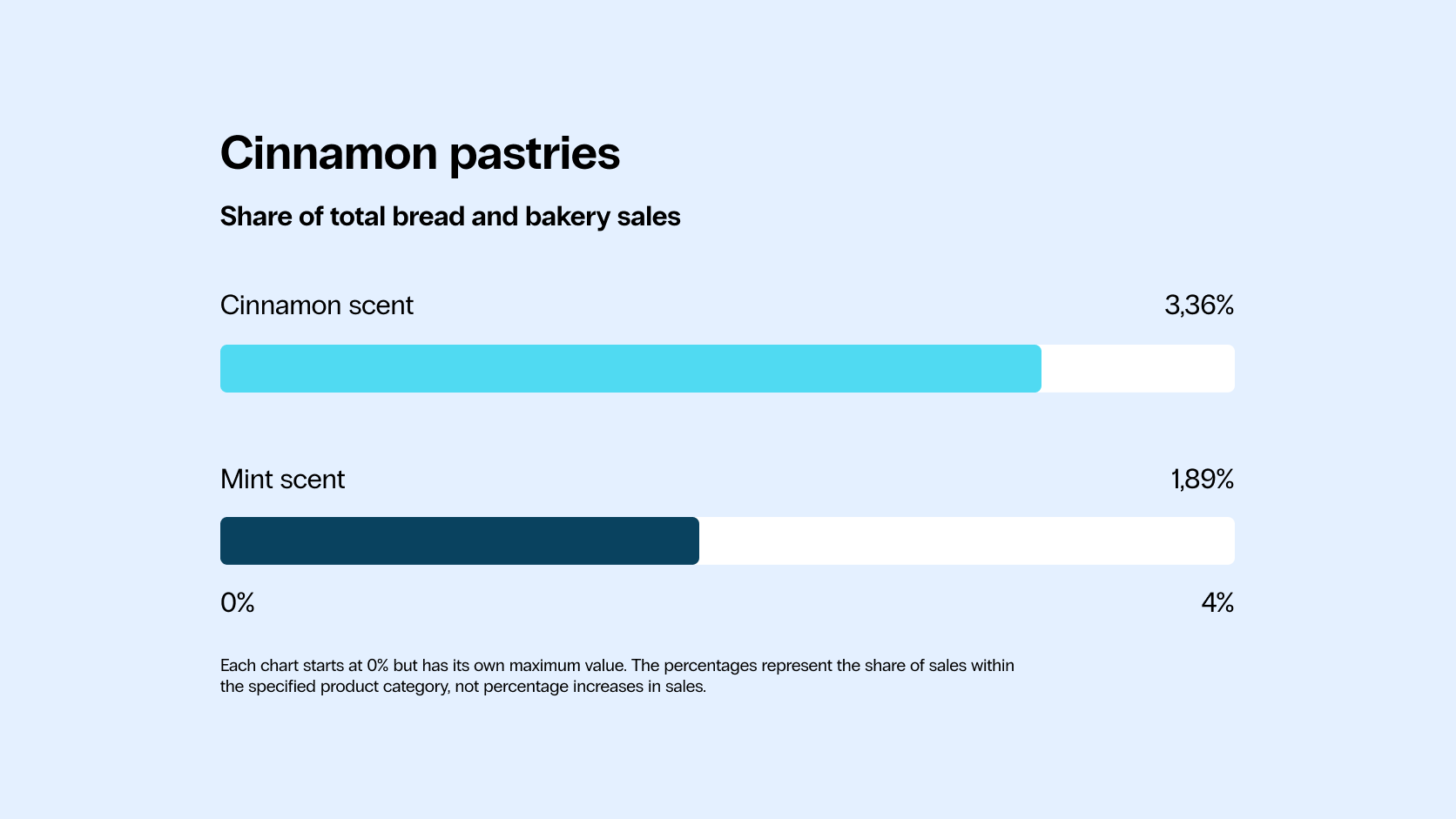
One of the clearest patterns emerged with cinnamon. On all three study days when cinnamon scent was diffused, sales of cinnamon pastries were higher than on days with mint scent.
On cinnamon-scented days, cinnamon pastries accounted for an average of 3.36% of total daily bread and bakery sales. On days with mint scent, this figure was 1.89%. Cinnamon pastry sales were also higher with cinnamon scent than on days without added scent.
These findings suggest that a recognisable scent may be associated with higher sales of products directly linked to that scent.
Mint-flavoured sweets as a share of confectionery sales
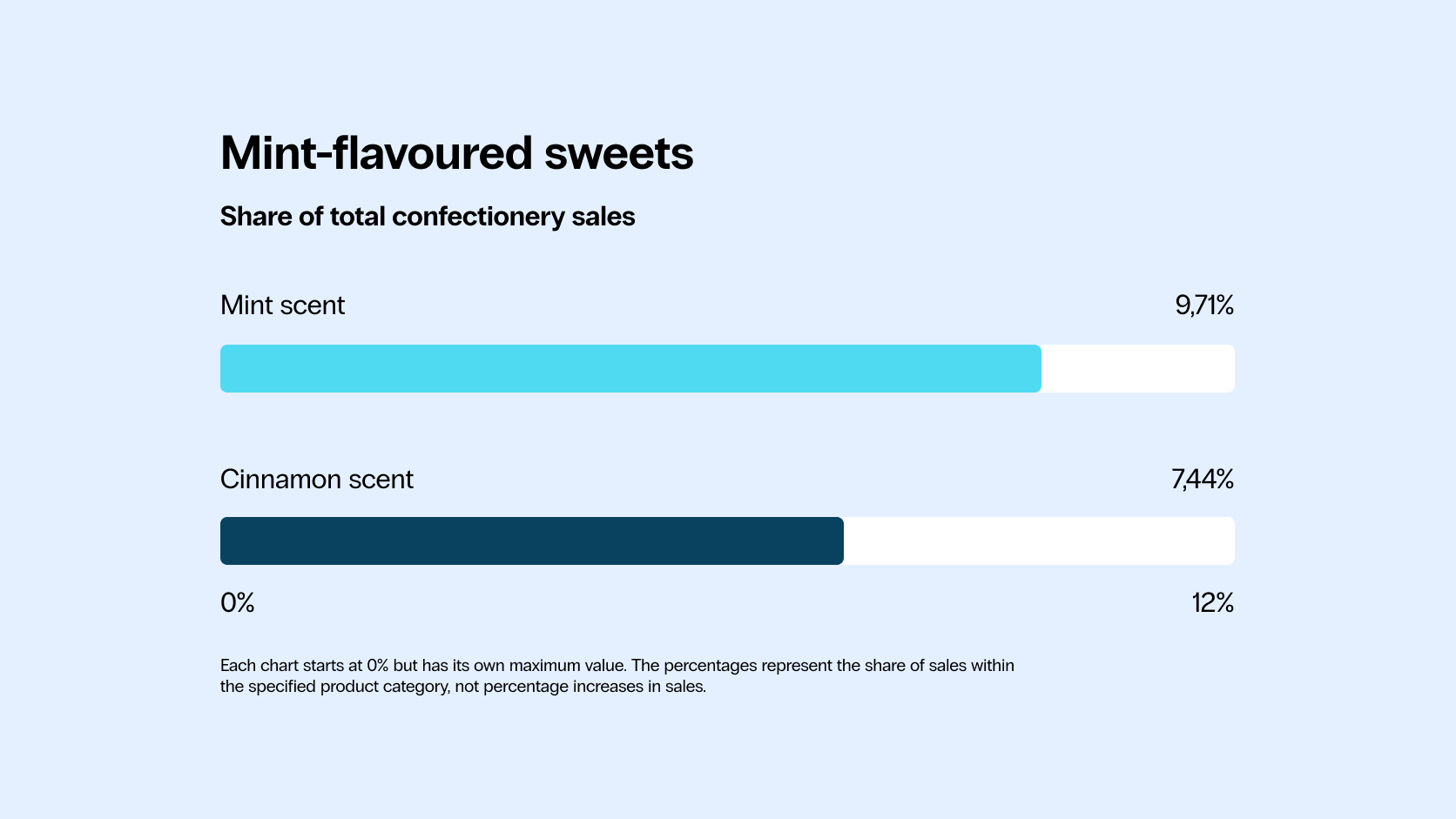
This experiment included six days with mint scent, six with cinnamon scent and five without added scent. On five of the six mint-scented days, sales of mint-flavoured confectionery were higher than on days with cinnamon scent.
The average share of mint-flavoured products within total confectionery sales was also higher:
- With mint scent: 9.71%
- With cinnamon scent: 7.44%
The researchers also reported that average sales of mint-flavoured confectionery were higher with mint scent than on days without added scent
Sweet baked goods and apples within their respective categories
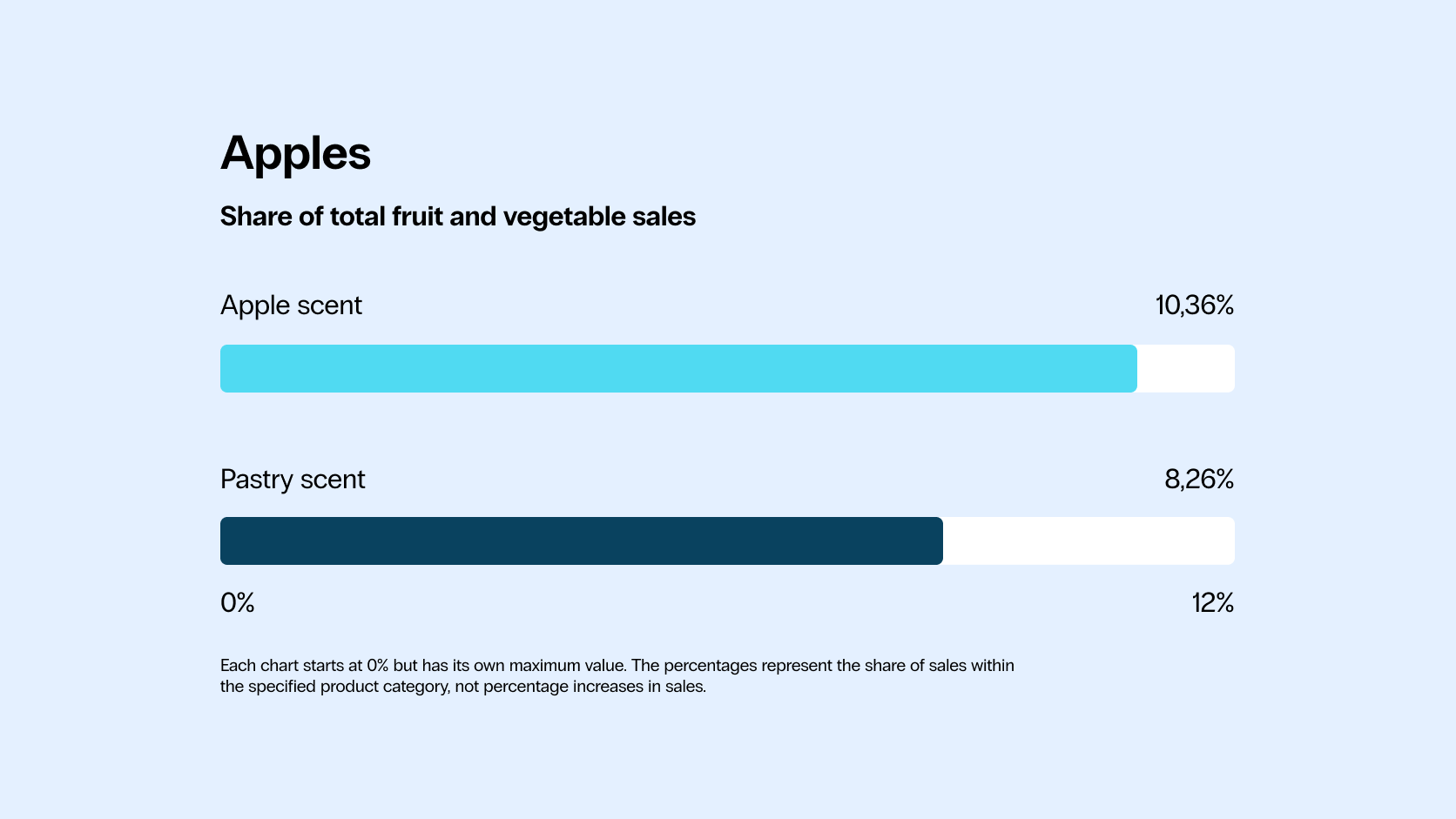
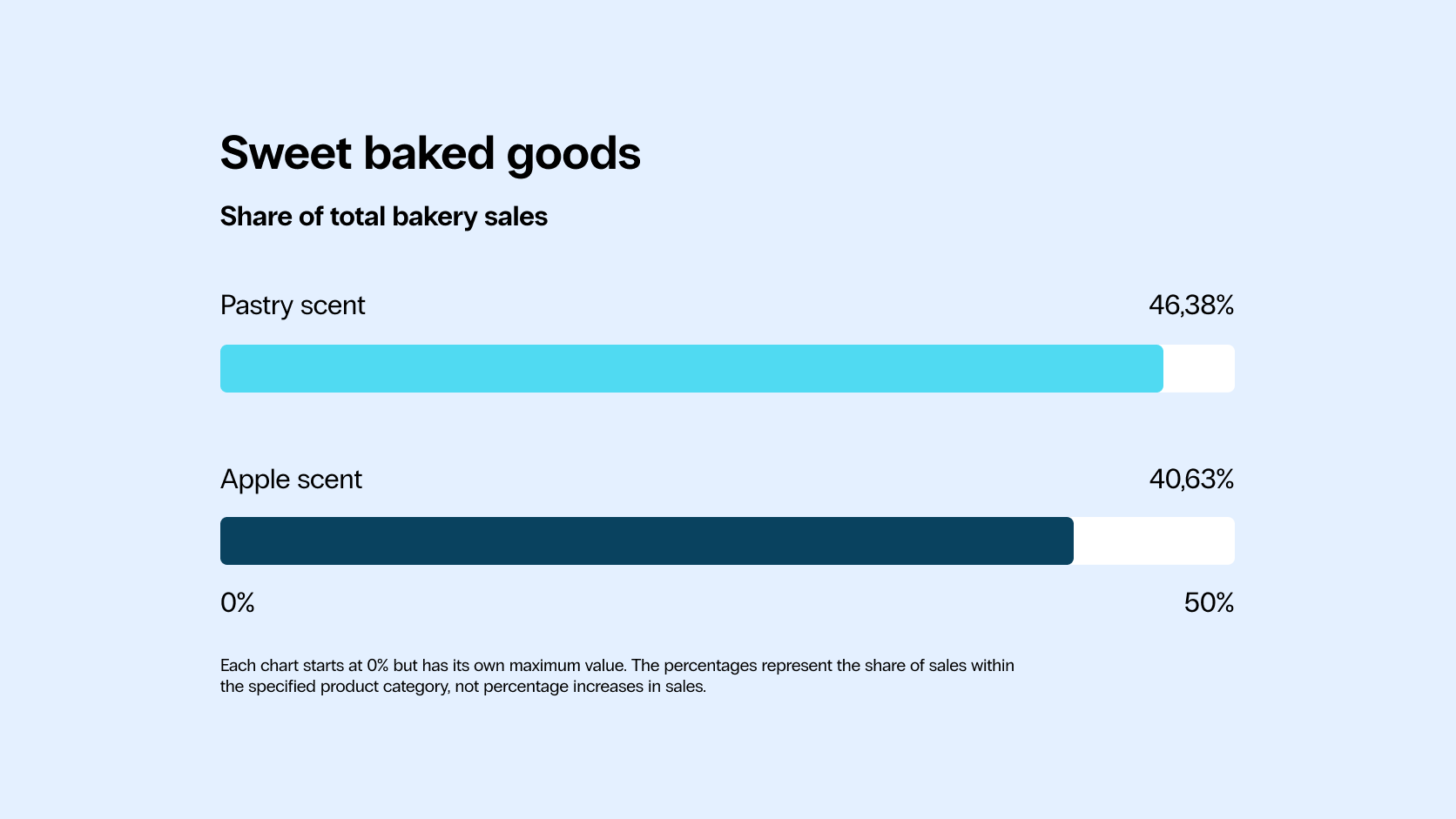
The second experiment also revealed some interesting differences. When the supermarket smelled of apples, apples accounted for a larger share of fruit and vegetable sales than when cheesecake scent was used (10.36% compared with 8.26%). With cheesecake scent, the opposite pattern appeared for sweet baked goods. Their share of total bakery sales was 46.38%, compared with 40.63% during apple-scented days.
Interestingly, the pattern extended beyond the products themselves. With apple scent, apple drinks and apple purée also accounted for a higher share of sales. With cheesecake scent, the same was true for sweet biscuits and baking ingredients.
This suggests that a scent doesn't necessarily have to match a product exactly. Products that shoppers associate with a particular scent may also be influenced.
For example, with apple scent, apple drinks accounted for 53.70% of cider sales, compared with 25.39% with cheesecake scent. Apple purée also performed relatively better when apple scent was diffused.
A similar pattern emerged with cheesecake scent. Sweet biscuits represented 56.41% of total biscuit sales, compared with 45.98% during apple-scented days. Baking ingredients also performed better under the cheesecake scent condition.
Does scent affect every product category in the same way?
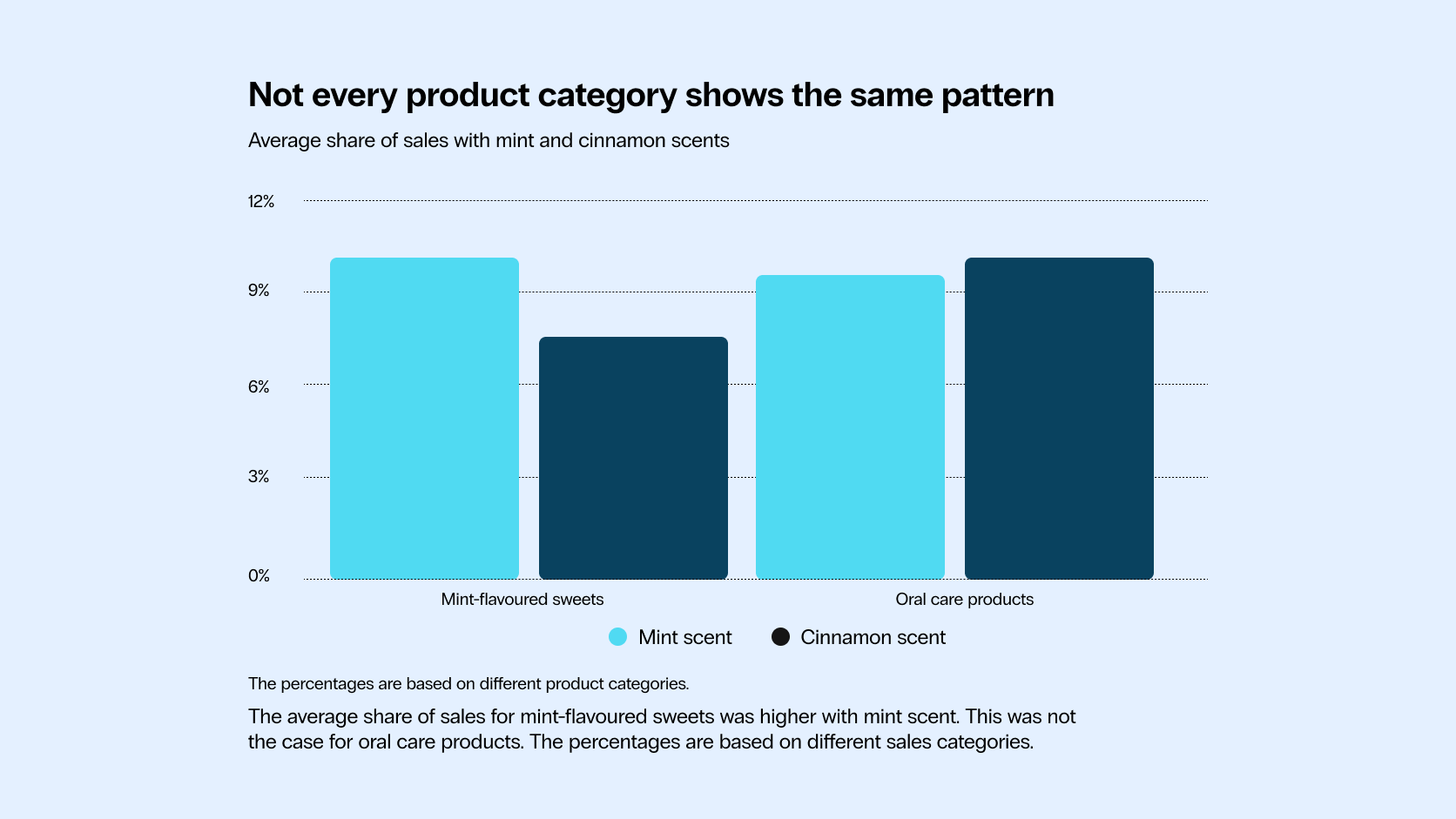
Not necessarily. The researchers also examined mint-flavoured oral care products, mainly toothpaste. Here, the results were less consistent. On four of the six mint-scented days, sales of these products were higher than on days with cinnamon scent. However, their average share of personal care sales was slightly lower with mint scent than with cinnamon scent.
One possible explanation suggested by the researchers is the difference in purchasing behaviour. Confectionery is often bought on impulse, while toothpaste tends to be a more practical, planned purchase.
This raises an interesting question: could scent have a greater influence on products that shoppers decide to buy in the moment?
The study doesn't prove this, but it does suggest that product category and purchasing behaviour may play an important role.
Why does matching scent to product matter?
An apple scent alongside a display of fresh apples feels like a natural fit. Just like cinnamon scent near cinnamon pastries. In scent marketing, this is known as scent congruence: how closely a scent matches a product, environment or experience. The Swedish study found that products matching the scent being diffused, or associated with it, often accounted for a higher share of sales.
This suggests that effective scent marketing isn't simply about making a space smell pleasant. It's about finding the right combination of scent, product and context.
A scent that complements the products on display could therefore be a valuable addition to both product presentation and the overall shopping experience.
What can retailers learn from the study?
The research offers a different perspective on scent marketing. Rather than seeing scent purely as a way to create a pleasant shopping experience, retailers can also consider its potential to support specific product categories and commercial objectives.
Three insights stand out:
- Match the scent to the product. A recognisable scent that naturally complements a product may help strengthen the product experience.
- Consider purchasing behaviour. The findings for mint-flavoured sweets and toothpaste suggest that impulse purchases and planned purchases may respond differently to scent.
- Look beyond individual products. A scent can also create associations with related products. Think of apple scent alongside different apple-based products, or cheesecake scent near other sweet treats.
The key takeaway? Choosing the right scent starts with understanding what you want to achieve.
What does this study mean for scent marketing?
Scent marketing is about more than making a space smell nice. This study suggests that scent can also be used strategically to complement specific products and the moments when shoppers make purchasing decisions.
That's what makes the research particularly interesting for retailers. Rather than relying on shoppers' opinions about scent, the researchers analysed what people actually bought.
In many cases, the findings showed a similar pattern: products that matched or were associated with the scent being diffused accounted for a higher share of sales. However, this wasn't the case for every product category studied.
For us, the research highlights the importance of choosing scent with a clear purpose. The right scent shouldn't just smell good. It should complement the environment, the products and the experience you want to create.
About the study
The experiments were conducted in 2017 at ICA Supermarket Mullsjö in Sweden, in collaboration with Aroma Marketing.
The first study ran from 5 October to 4 November, comparing cinnamon scent, mint scent and no added scent. The second ran from 6 November to 2 December, comparing apple scent, cheesecake scent and no added scent.
Sales data were analysed at department, product category and individual product level.
The research report was published by Kaisa Lund on 30 July 2018 and is available to download here.
Start your scent experience!
Wondering which scent best suits your store, products or business goals? Our scent experts are here to help you create a scent experience that not only smells great, but also supports what you want to achieve.