How do you make a product display not only stand out, but work smarter too? During a nine-week field test in a German supermarket in Aschaffenburg, researchers investigated what happens when scent marketing, real-time stock monitoring and data analysis come together in one smart retail display.
The test was carried out in collaboration with Eizenhöfer Displays, Kaffee Braun, neoalto/POS Tuning, Sense Company and Aschaffenburg University of Applied Sciences. The complete research methodology and results are documented in the German final report, Abschlussbericht aus dem Gemeinschaftsprojekt zur Erprobung eines intelligenten Displays in den Bereichen olfaktorisches Marketing und Warenbestandsmessung.
The results are interesting. In the test supermarket, revenue was 41.9% higher than during the same period a year earlier, while 7.9% more products were sold. By comparison, across the twelve other supermarkets included in the analysis, revenue fell by an average of 2.0% and the number of products sold decreased by 18.3%.
The field test shows the potential impact of combining scent marketing with strong product presentation, smart stock monitoring and data-driven assortment optimisation. It was precisely this combination that delivered such a striking result on the shop floor.
In this blog, we explore:
- Why a smarter display was needed
- What exactly was investigated
- How the field test was structured
- How scent affected customer attention
- What impact the test had on revenue
- Why scent is interesting on the shop floor
- What retailers can learn from this field test
- Whether a scent-enabled display could work for product categories beyond coffee
- What this test means for scent marketing
- More about the research
Why is a smarter display needed?
Today, retailers have access to more data and technology than ever to optimise sales, stock and in-store processes. But when it comes to temporary displays, secondary product placements away from the regular shelf and specific product presentations, gaining real-time insight into what is actually happening can still be challenging.
How quickly is a particular product being taken from the display? When does it need restocking? Which variants perform best? And how can the presentation be adjusted using current data rather than relying solely on historical sales figures?
There is another challenge too: attention. On a shop floor where countless brands and products are competing for the customer's attention, simply being visible is not always enough.
The research project therefore brought together three key elements: experience and attention on the shop floor, real-time insight into stock and sales, and data-driven assortment optimisation.
What exactly was investigated?
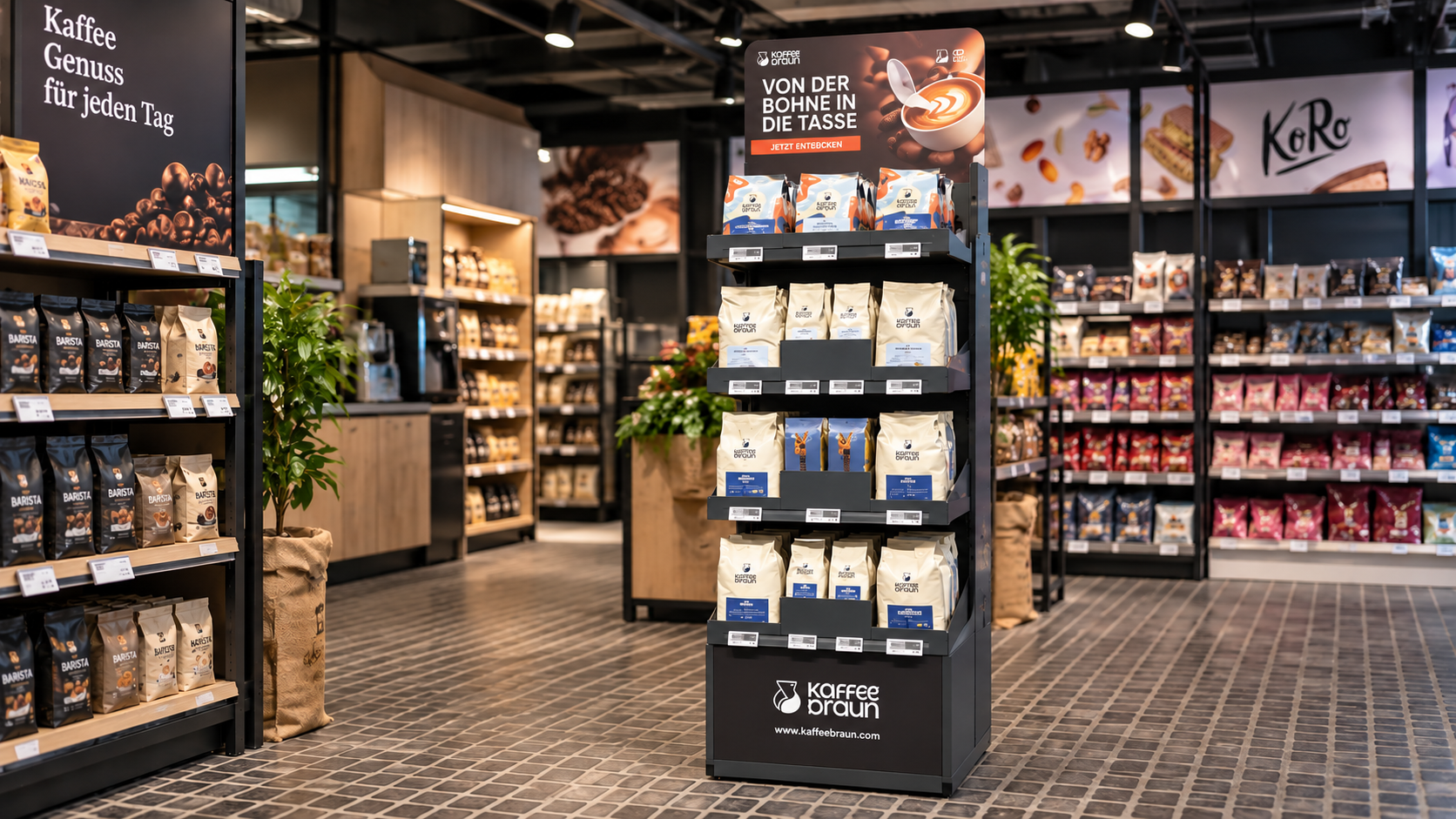
For the project, a coffee display was developed that combined three applications:
- A modular product display
- Sensors that continuously measured current stock levels
- An integrated scent marketing system that released a targeted coffee scent
Stock data was sent to a digital platform in real time. This made it possible to monitor which products were being taken, how much stock remained and when restocking was required.
Sense Company provided the scent technology and scent composition for the project. The system was integrated directly into the display, allowing the coffee scent to be distributed specifically around the product presentation.
How was the field test structured?
The test took place at EDEKA Stenger in Aschaffenburg and lasted a total of nine weeks. Three different situations were compared:
- Baseline: sales without the new display
- Smart display with scent: the new display with active scent diffusion
- Smart display without scent: the same display, but without scent
The three phases ran from 15 October to 17 December 2025.
In addition to sales and stock data, customers were surveyed about factors including attention, dwell time and their experience of the display. Aschaffenburg University of Applied Sciences was responsible for the scientific supervision and analysis of the customer research.
What effect did scent have on customer attention?
The research results suggest that scent can contribute to a more noticeable and appealing display. Customers responded more positively to each of the following statements when scent was present compared with the situation without scent:
- The coffee display caught my attention
- I felt drawn to the coffee display
- I spent longer than usual near the coffee section
- I noticed a particular scent near the coffee products
The difference in scent perception was statistically significant. The situation with scent also scored more positively on the other measures. Although these differences were not statistically significant, they do indicate a clear positive trend.
What was the impact on revenue?
The sales results were particularly striking. Revenue in the test supermarket increased by 41.9% compared with the same period a year earlier, while the number of products sold increased by 7.9%.
By comparison, across the twelve other supermarkets included in the research, revenue fell by an average of 2.0% and sales volume decreased by 18.3%.
Another analysis within the project found that monthly revenue increased by 63% following assortment optimisation.
It is important to note that the increase in revenue cannot be attributed solely to scent marketing. The optimised assortment also played an important role. Above all, the results demonstrate the potential of scent marketing when used as part of a broader approach to optimising the shop floor.
Why is scent interesting on the shop floor?
Scent differs from many other marketing stimuli because it becomes a direct part of the physical in-store experience.
For products with a recognisable scent profile, such as coffee, bread, cosmetics or personal care products, scent can enhance the presentation. Customers do not simply see the product. They can experience it too.
During this field test, customers were more likely to say that the coffee display caught their attention, appealed to them and encouraged them to spend longer near the shelf. Not all of these differences were statistically significant, but taken together, the researchers suggest they demonstrate the potential of scent as an additional stimulus at the point of sale.
What can retailers learn from this?
For us, the main lesson from this field test is not that one individual technology was responsible for the result. It is the combination that makes it particularly interesting.
Real-time stock data shows what is happening on the shelf. Data analysis helps optimise the assortment and replenishment. Strong product presentation creates visibility. And scent adds an extra sensory and emotional layer to the experience.
The case therefore demonstrates how commercial performance and operational efficiency can be measured and optimised together within a single retail concept.
In the German final report, the combination of sensor technology, data analysis and scent marketing is described as an interesting foundation for a broader smart POS ecosystem.
Is a smart scent display only interesting for coffee?
No. According to the researchers, the principle could also be applied to other product categories and retail environments. For example:
- Cosmetics and personal care
- Bakery and fresh products
- Confectionery and snacks
- Beverages
- Shop-in-shop concepts
- Temporary promotions
Product categories where impulse purchases, product experience and a recognisable scent play an important role could be particularly interesting for this type of application.
What does this test mean for scent marketing?
Above all, this case demonstrates how scent marketing can increasingly be connected to measurable retail data.
Where scent was traditionally used primarily to create atmosphere and strengthen brand experience, it can now become part of a much broader, data-driven retail concept.
That changes the question too. It is no longer simply: does the store smell better? The more interesting question is: what happens to attention, behaviour and sales when scent is added to the in-store experience?
That is exactly the kind of question we at Sense Company are increasingly exploring together with retailers and brands.
About the research
The field test was carried out at EDEKA Stenger in Aschaffenburg in 2025. Eizenhöfer Displays, Kaffee Braun, neoalto/POS Tuning, Sense Company and Aschaffenburg University of Applied Sciences were involved in the project.
The test lasted nine weeks and consisted of a baseline period, a period using the smart display with scent and a period using the same display without scent.
This field test highlights the potential of scent marketing as part of a smart retail strategy. When combined with strong product presentation and data-driven optimisation, scent can add another layer of impact to the shop floor.
Want to read the full German research report?
Explore all results, the complete research methodology and conclusions in the German final report.
Start with scent experience!
Curious how scent marketing and smart retail technology can transform your in-store experience? Our scent experts are happy to help you develop a scent solution tailored to your brand, your customers and your retail environment.